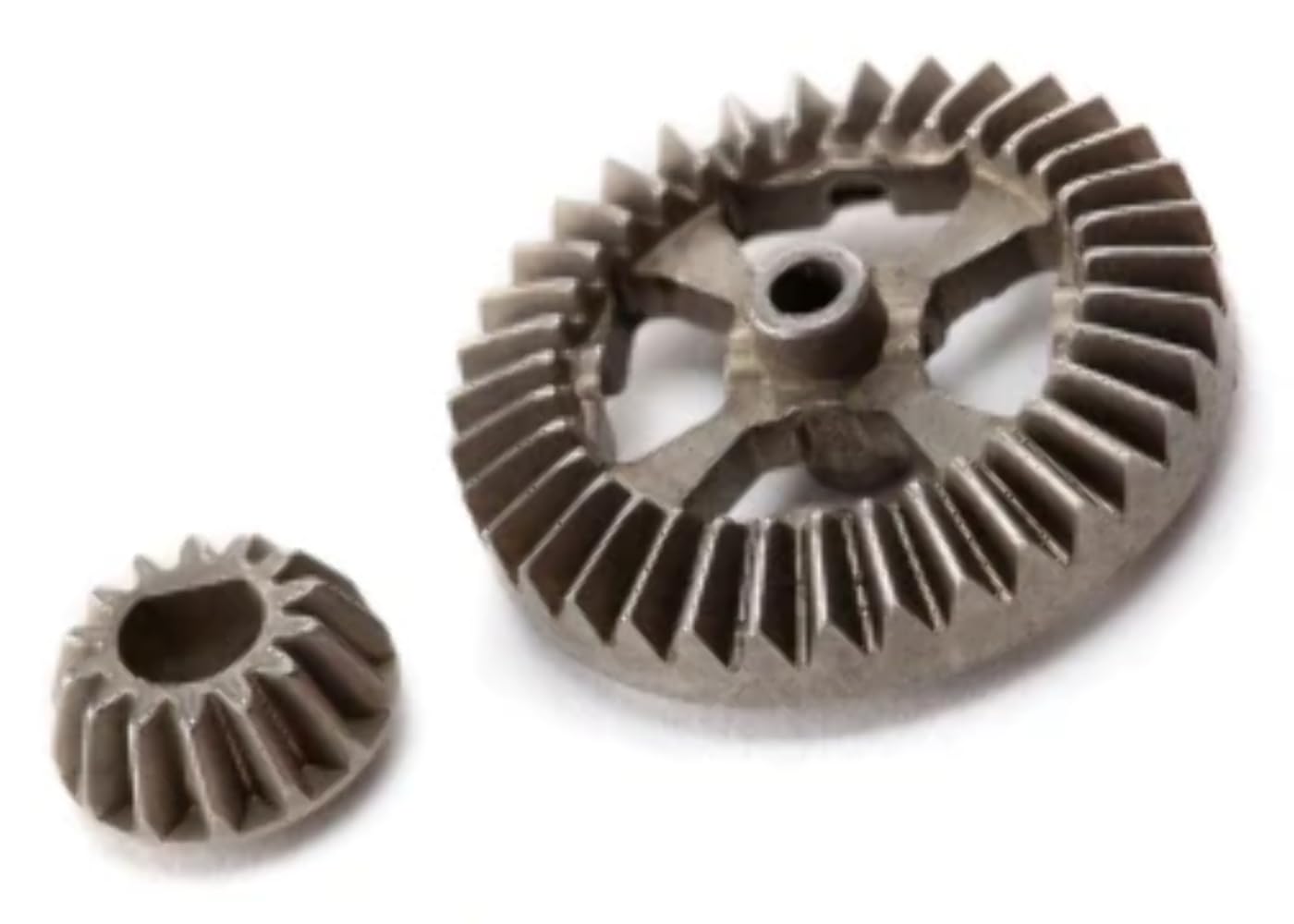
China Hot selling Gear Kit Basin Angle Gear Ring and Pinion Gear 8-97083-126-0 for CZPT Npr 7/41 with Best Sales
Product Description
Product Description
| Car Fitment | Isuzu |
| OE No. | 8-97083-126-0 |
| Speed Ratio | 7/41 |
| Type | Differential Gear |
| Material | 20CrMnTi/ 8620 |
| Hardness | HRC58-62 |
| Treatment | Carburizing,Hardening, tempering,high frequency treatment,black coating,zincing,nickelage |
Company Profile
HangZhou CHINAMFG Machinery is a professional manufacture of spiral bevel gear. The company has CNC milling machine, the GLEASON milling machine, rolling inspection machine, gear measuring center, a full set of metallographic analysis, inspection equipment and other related advanced equipment.
Our company owns gear measuring center equipped with advanced testing machines such as contourgraph, universal measuring microscope and full set netlaaographic analysis detector. According to various technical requirements and through procedures of sampling, special inspection and re-examination, multi-indexes of gears like observation, measurement and tracking can be completed.
With our high quality products, high credibility and trusty cooperation, aiming to be a highly specialized gear manufacturer of high level and all-directional service,we are looking CHINAMFG to your business negotiation and our promising cooperation.
FAQ
Q1: Are your products standard?
A: Our model is standard, if you have specific demand, pls tell us the details.
Q2: What is you main categories?
A: CHINAMFG truck parts, CHINAMFG truck parts, Hino truck parts, CHINAMFG truck parts,Toyota truck parts, Mazda truck parts,Suzuki truck parts,etc.
Q3: If we don’t find what we want on your website, what should we do?
A: You can email us the descriptions and pictures of the products you need, we will check whether we have them.
B: We develop new items every month, and some of them have not been uploaded to website in time. Or you can send us sample by express, we will develop this item for bulk purchasing.
Q4: What is your terms of payment?
A: T/T 30% as deposit, and 70% before delivery. We’ll show you the photos of the products and packages before you pay the balance.
Q5:Do you test all your goods before delivery?
Yes, we have 100% test before delivery.
| Application: | Motor, Electric Cars, Motorcycle, Machinery, Agricultural Machinery, Car |
|---|---|
| Hardness: | Hardened Tooth Surface |
| Gear Position: | External Gear |
| Manufacturing Method: | Cut Gear |
| Toothed Portion Shape: | Curved Gear |
| Material: | Cast Steel |
| Customization: |
Available
| Customized Request |
|---|
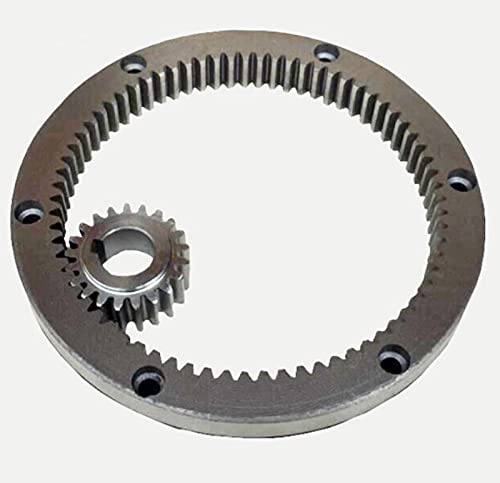
What is the purpose of using ring gears in machinery?
Ring gears serve multiple purposes and offer various advantages when used in machinery. Here’s a detailed explanation of the purpose of using ring gears:
- Power Transmission: One of the primary purposes of ring gears in machinery is to facilitate power transmission. Ring gears, along with other meshing gears, transmit torque and rotational motion from the driving gear to the driven components or systems. They enable the transfer of power from a power source to various parts of the machinery, driving the movement and operation of different mechanisms and processes.
- Gear Ratio Control: Ring gears allow for precise control over the gear ratio in machinery. By adjusting the size of the ring gear and its meshing gears, different gear ratios can be achieved. Gear ratios determine the relationship between the rotational speeds and torques of the driving and driven gears. This ability to control the gear ratio enables machinery to operate at desired speeds, optimize torque output, and adapt to specific application requirements.
- Mechanical Advantage: Ring gears provide a mechanical advantage in machinery. By leveraging the gear ratio control mentioned above, ring gears can amplify or reduce the torque output of the power source. This mechanical advantage allows machinery to generate higher forces or torques than the original power source alone. It enables the machinery to handle heavy loads, perform tasks requiring significant force, and enhance overall operational efficiency.
- Load Distribution: Ring gears contribute to load distribution within machinery. The meshing teeth of the ring gear engage with multiple teeth of other gears, distributing the transmitted loads across these meshing points. This load distribution helps prevent excessive stress concentration on specific gear teeth, ensuring even wear and reducing the risk of gear failure. By distributing the load, ring gears enhance the overall durability and reliability of the machinery.
- Motion Control: Ring gears play a crucial role in motion control within machinery. By transmitting rotational motion, ring gears enable precise movement and synchronization of various components and mechanisms. They ensure that different parts of the machinery operate in a coordinated manner, allowing for smooth and controlled motion. Ring gears contribute to accurate positioning, speed regulation, and overall motion precision in machinery.
- Compact Design: Ring gears offer a compact design solution. Due to their annular shape, they can be integrated into machinery with limited space. The compactness of ring gears is particularly beneficial in applications where space constraints are a concern. Their small footprint allows for efficient use of available space, enabling the design of more compact and lightweight machinery without sacrificing power transmission capabilities.
- Versatile Applications: Ring gears find wide applications across various industries and machinery types. They are used in automotive transmissions, industrial machinery, robotics, aerospace systems, power generation equipment, and more. The versatility of ring gears stems from the ability to configure them in different types, such as external or internal ring gears, helical gears, or bevel gears. This versatility makes ring gears adaptable to a wide range of machinery designs and requirements.
By serving these purposes, ring gears contribute to the efficient and reliable operation of machinery. They enable power transmission, gear ratio control, mechanical advantage, load distribution, motion control, and compact design, making them essential components in various mechanical systems.
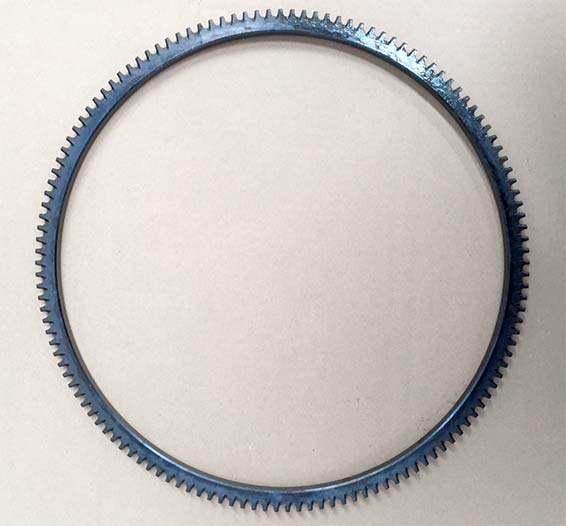
How do you prevent backlash and gear play in a ring gear mechanism?
Preventing backlash and gear play in a ring gear mechanism is crucial for ensuring accurate and precise operation. Here’s a detailed explanation of how to prevent backlash and gear play in a ring gear mechanism:
- Precise Gear Design: The design of the ring gear and associated gears should be carefully engineered to minimize backlash. This involves selecting appropriate tooth profiles and gear geometry that promote proper meshing and minimize clearance between the gear teeth. The gear design should consider factors such as tooth thickness, pressure angle, and tooth contact ratio to achieve optimal gear meshing without excessive play.
- Tight Manufacturing Tolerances: Close manufacturing tolerances are essential to reduce backlash in a ring gear mechanism. The gear components, including the ring gear and mating gears, should be produced with high precision to ensure accurate tooth dimensions and minimize any gaps or play between the gear teeth. Tight manufacturing tolerances help achieve a tighter meshing fit, reducing backlash and gear play.
- Proper Gear Alignment: Accurate alignment of the ring gear and mating gears is crucial for minimizing backlash. The gears should be properly aligned along their axes to ensure precise engagement and minimize any misalignment that can contribute to play. Adequate alignment can be achieved through careful assembly techniques, such as using alignment fixtures, proper shimming, and precision measurement tools.
- Preload or Pre-tension: Applying preload or pre-tension to the ring gear mechanism can help reduce backlash and gear play. Preload involves applying a slight compressive force or tension to eliminate any clearance or gaps between the gear teeth during operation. This can be achieved through various methods, such as using spring-loaded components, adjustable shims, or axial preloading devices.
- Optimized Lubrication: Proper lubrication is essential for reducing friction and minimizing gear play. Lubricants with appropriate viscosity and film strength should be used to ensure smooth gear operation and reduce any unwanted movement or play between the gear teeth. Regular lubricant maintenance, such as monitoring oil levels and replenishing or replacing lubricants as needed, helps maintain optimal lubrication conditions and minimize backlash.
- Mechanical Backlash Compensation: In some applications, mechanical compensation mechanisms can be employed to actively compensate for any residual backlash. These mechanisms can include systems with adjustable clearances, anti-backlash devices, or dual-gear arrangements that counteract the effects of backlash. Mechanical backlash compensation techniques can help maintain precise positioning and eliminate any undesired play in the gear mechanism.
By implementing these measures, it is possible to significantly reduce or eliminate backlash and gear play in a ring gear mechanism. Careful gear design, tight manufacturing tolerances, proper alignment, preload or pre-tension, optimized lubrication, and mechanical compensation techniques all play a role in ensuring accurate and precise operation of the ring gear mechanism.
What is a ring gear and how does it work?
A ring gear is a type of gear that features teeth on the outer perimeter of a circular ring-shaped component. It is commonly used in various mechanical systems and applications. Here’s a detailed explanation of what a ring gear is and how it works:
A ring gear, also known as an annular gear or internal gear, is a gear with teeth on the inside circumference of a circular ring. It is designed to mesh with a pinion gear or another gear that has teeth on the outside. The combination of a ring gear and a pinion gear forms a gear set, enabling the transmission of rotational motion and torque between the two gears.
Here’s how a ring gear works:
- Tooth Engagement: When a ring gear and a pinion gear are brought together, the teeth of the pinion gear mesh with the teeth of the ring gear. The teeth of the pinion gear enter the spaces between the teeth of the ring gear, creating a mechanical connection between the two gears.
- Motion Transmission: As the driving gear (such as the pinion gear) rotates, it transfers rotational motion to the ring gear. The teeth of the driving gear push against the teeth of the ring gear, causing the ring gear to rotate in the opposite direction. This rotational motion can be used to drive other components or systems connected to the ring gear.
- Torque Transfer: The meshing of the teeth between the ring gear and the driving gear allows for the transfer of torque. Torque is the rotational force or twisting force applied to a gear. As the driving gear exerts torque on the ring gear through the meshing teeth, the ring gear experiences a torque load. This torque load can be transmitted to other components or systems connected to the ring gear.
- Gear Ratio: The gear ratio between the ring gear and the driving gear determines the speed and torque relationship between the two gears. The gear ratio is defined as the ratio of the number of teeth on the ring gear to the number of teeth on the driving gear. By changing the size or number of teeth on either the ring gear or the driving gear, the gear ratio can be adjusted to achieve the desired speed or torque output.
- Load Distribution: The ring gear distributes the load over a larger area compared to other types of gears. This load distribution characteristic allows the ring gear to handle higher loads and torque. The design of the ring gear and its tooth profile ensures that the load is evenly distributed across the surface of the gear, enhancing its durability and reducing the risk of premature wear or failure.
Ring gears are commonly used in various applications, including automotive transmissions, differential systems, planetary gear systems, industrial machinery, and power transmission equipment. They provide advantages such as compactness, high torque capacity, load distribution, and the ability to achieve high gear ratios.
It’s important to note that the design and characteristics of ring gears may vary depending on the specific application and requirements. Factors such as tooth profile, material selection, lubrication, and manufacturing techniques are carefully considered to ensure optimal performance and durability of the ring gear.


editor by CX 2023-11-27