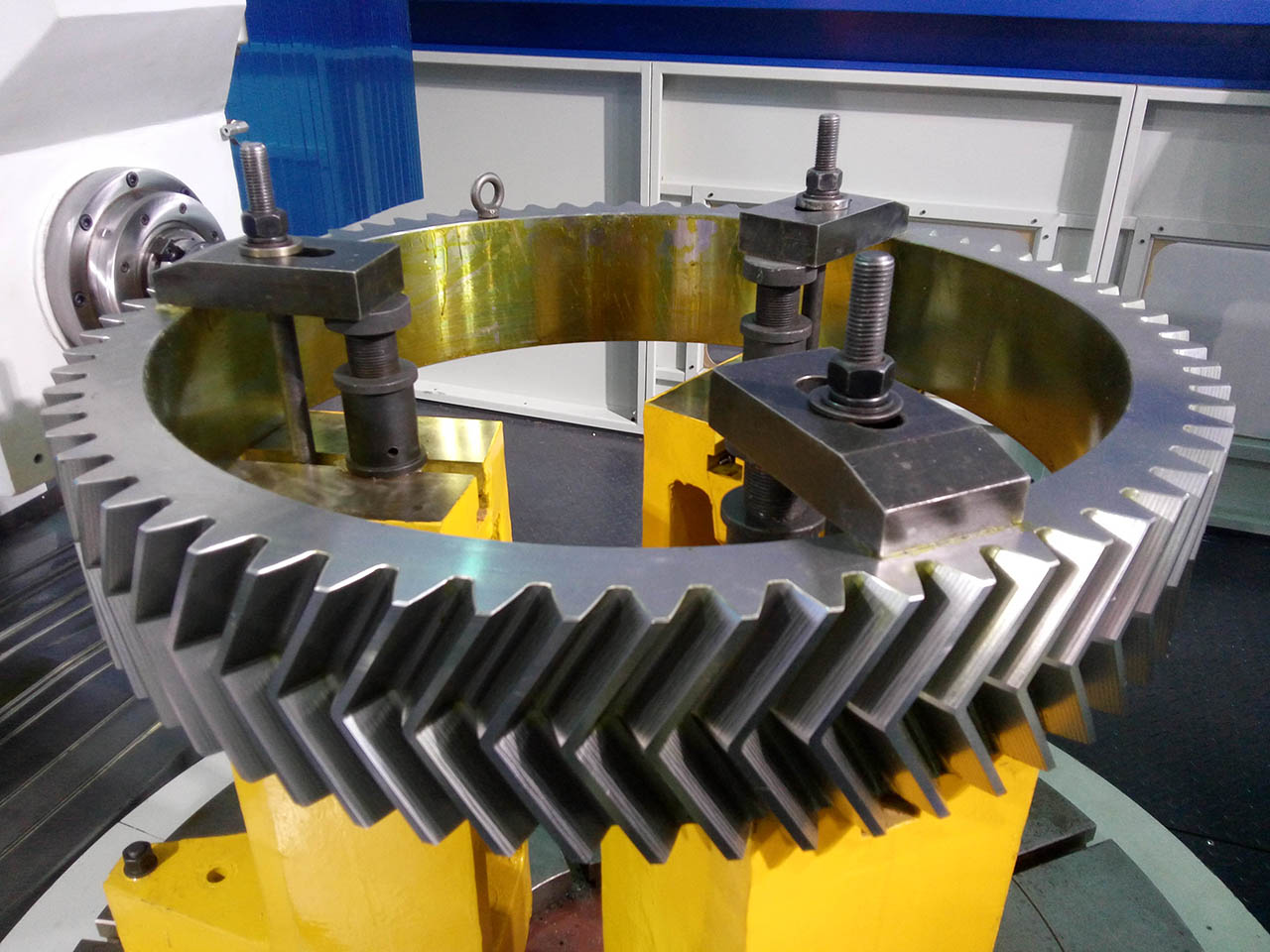
China factory China Suppliers Large Module Cast Steel Herringbone Helical Gear spurs gear
Product Description
Key attributes
Other attributes
Applicable Industries
Manufacturing Plant, Construction works , Energy & Mining
Weight (KG)
3000
Showroom Location
None
Video outgoing-inspection
Provided
Machinery Test Report
Provided
Marketing Type
Ordinary Product
Warranty of core components
Not Available
Core Components
Gear, Ring Gear
Place of CHINAMFG
ZheJiang , China
Condition
New
Warranty
1year
Shape
Ring Gear
Standard or Nonstandard
Nonstandard
Tooth Profile
Helical Gear,spur gear
Material
Steel
Processing
Forging
Pressure Angle
custom
Brand Name
TS
Product Name
Large Ring Gear
Module No.
5-180
Process
Milling,hobbing
Surface treatment
as request
Heat treatment
Q&T
Application
Industry machinery,transmission equipment
Standard
DIN ANSI ISO
Certificate
ISO
OEM Service
YES
Delivery time
15-60days
Packaging and delivery
Packaging Details
Package adapting to CHINAMFG transport
Port
ZheJiang ,HangZhou
Supply Ability
Supply Ability
5 Piece/Pieces per Month
OUR WORKSHOPS
OUR EQUIPMENTS
Technology Process
|
Material |
Carbon steel,Alloy steel |
||
|
Structure |
Forging,casting |
||
|
Type of gear |
spur gear,helical gear,Planetary Gear |
||
|
Heat treatment |
Quenching and tempering |
||
|
Process |
forging, rough machining, QT, finish machining |
||
|
Main equipments |
hobbing,CNC machine |
||
|
Module |
up to 200 |
||
|
Precision of gear |
Grinding ISO Grade 5-7 & Hobbing ISO Grade 8-9 |
||
|
Inspection |
Raw material inspection, UT,physical property test,dimension inspect |
||
|
Application |
Mining machinery, mill, kiln and other equipment |
||
OUR CERTIFICATE
OUR CUSTOMER FEEDBACK
CONTACT
/* March 10, 2571 17:59:20 */!function(){function s(e,r){var a,o={};try{e&&e.split(“,”).forEach(function(e,t){e&&(a=e.match(/(.*?):(.*)$/))&&1
| Application: | Industry |
|---|---|
| Hardness: | Hb190-Hb300 |
| Gear Position: | External Gear |
| Samples: |
US$ 100/Piece
1 Piece(Min.Order) | Order Sample |
|---|
| Customization: |
Available
| Customized Request |
|---|
.shipping-cost-tm .tm-status-off{background: none;padding:0;color: #1470cc}
| Shipping Cost:
Estimated freight per unit. |
about shipping cost and estimated delivery time. |
|---|
| Payment Method: |
|
|---|---|
|
Initial Payment Full Payment |
| Currency: | US$ |
|---|
| Return&refunds: | You can apply for a refund up to 30 days after receipt of the products. |
|---|
What are the benefits of using a herringbone gear mechanism?
Using a herringbone gear mechanism offers several benefits due to its unique design and characteristics. Here’s a detailed explanation of the advantages of using a herringbone gear mechanism:
- High Load Capacity: Herringbone gears are capable of handling high torque loads due to their double helical tooth design. The opposing helix angles of the two sides of the gear create a balanced load distribution, allowing for increased load-carrying capacity compared to other gear types. This makes herringbone gears suitable for applications that involve heavy loads and high power transmission requirements.
- Bidirectional Power Transmission: Herringbone gears are capable of transmitting power in both directions. The double helical tooth profile cancels out axial thrust forces that would occur in single helical gears, allowing for bidirectional power transfer without the need for additional thrust bearings or special mechanisms. This feature is particularly advantageous in applications where reversible power transmission is required.
- Smooth and Quiet Operation: The double helical tooth design of herringbone gears helps to cancel out axial and radial forces, resulting in smooth and quiet operation. The opposing helix angles of the two sides of the gear minimize gear vibrations and reduce noise levels during engagement. This makes herringbone gears suitable for applications where low noise and vibration are desired, such as precision machinery, printing presses, and automotive transmissions.
- Improved Gear Tooth Strength: The double helical tooth design of herringbone gears provides enhanced tooth strength compared to single helical gears. The opposing helix angles create a self-centering effect that reduces tooth deflection and improves load distribution along the tooth surfaces. This results in increased tooth strength, reduced wear, and improved overall gear durability, making herringbone gears suitable for high-load and high-speed applications.
- Efficient Torque Transfer: Herringbone gears offer efficient torque transfer due to their large contact area and overlapping tooth engagement. The double helical tooth profile provides a larger contact ratio compared to spur gears, resulting in improved power transmission efficiency and reduced stress concentrations on the gear teeth. This efficient torque transfer contributes to the overall performance and energy efficiency of the gear system.
- Axial Thrust Elimination: The double helical tooth profile of herringbone gears allows for the cancellation of axial thrust forces. The opposing helix angles create equal and opposite axial forces, effectively eliminating the net axial thrust on the gear shaft. This eliminates the need for additional thrust bearings or special provisions to counteract axial loads, simplifying the gear system design and reducing complexity and cost.
These are some of the key benefits of using a herringbone gear mechanism. Their high load capacity, bidirectional power transmission capability, smooth and quiet operation, improved tooth strength, efficient torque transfer, and axial thrust elimination make them advantageous in a wide range of applications across various industries.
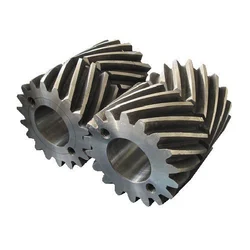
What are the advantages and disadvantages of using herringbone gears?
Herringbone gears offer several advantages and disadvantages that should be considered when evaluating their suitability for a specific application. Here’s a detailed explanation of the advantages and disadvantages of using herringbone gears:
Advantages of Herringbone Gears:
- Reduced Friction: The double helical arrangement of the teeth in herringbone gears helps cancel out axial thrust and minimize sliding friction during gear meshing. This results in reduced frictional losses, improving overall efficiency and reducing energy consumption.
- Smooth Operation: Herringbone gears provide smooth and quiet operation due to their gradual meshing and unmeshing characteristics. The opposing helix angles of the teeth enable smooth tooth engagement, reducing impact and vibrations, and enhancing overall system performance.
- High Torque Capacity: Herringbone gears have a larger surface area of contact compared to spur gears, allowing them to transmit higher torque loads. This higher torque capacity enables the use of more compact gear designs and reduces the need for additional gear stages, resulting in space and weight savings.
- Better Load Distribution: The double helical tooth arrangement in herringbone gears distributes the load more evenly across the gear face. This improves load-bearing capabilities, reduces stress concentrations, and enhances gear life and durability.
- Improved Alignment: Herringbone gears are self-aligning to a certain extent due to their double helical structure. This makes them more forgiving of minor misalignments, simplifying the alignment process during installation and reducing the risk of gear tooth damage.
- No Axial Thrust: The opposing helix angles of the teeth in herringbone gears cancel out the axial thrust. This eliminates the need for additional thrust bearings or complicated thrust balancing mechanisms, simplifying the overall gear system design.
Disadvantages of Herringbone Gears:
- Complex Manufacturing: Herringbone gears are more complex to manufacture compared to spur gears. The double helical tooth profile requires precise machining and specialized manufacturing processes, which can increase production costs.
- Tighter Tolerance Requirements: The double helical tooth profile of herringbone gears requires tight manufacturing tolerances to ensure proper gear meshing and alignment. This may require more stringent quality control measures during production and assembly.
- Increased Axial Space: Herringbone gears require additional axial space compared to spur gears due to their double helical structure. This can be a constraint in applications with limited axial space availability, requiring careful consideration during system design.
- Higher Complexity in Gearbox Design: Incorporating herringbone gears into a gearbox design can add complexity to the overall system. The need for proper gear alignment, balancing, and lubrication may require more sophisticated gearbox configurations and maintenance procedures.
- Specialized Maintenance: Herringbone gears may require specialized maintenance procedures, such as gear tooth inspection, alignment checks, and lubrication. This can involve additional time and effort compared to simpler gear systems.
When considering the use of herringbone gears, it is essential to evaluate the specific requirements of the application, including load capacity, operating conditions, space constraints, and cost considerations. Proper design, manufacturing, and maintenance practices can help leverage the advantages of herringbone gears while mitigating their disadvantages.
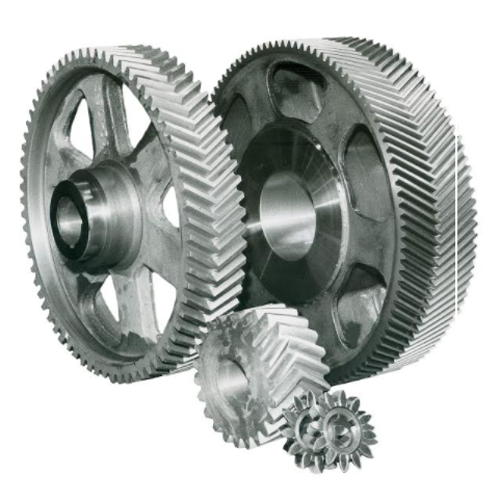
Are there different variations of herringbone gears available?
Yes, there are different variations of herringbone gears available to suit specific application requirements. Here’s a detailed explanation of some of the common variations of herringbone gears:
- Single- and Double-Sided: Herringbone gears can be classified as single-sided or double-sided based on the number of helical sections. Single-sided herringbone gears have a herringbone tooth profile on one side and a straight tooth profile on the other side. Double-sided herringbone gears have herringbone tooth profiles on both sides. Single-sided herringbone gears are commonly used when axial thrust elimination is not a primary requirement, while double-sided herringbone gears provide superior axial thrust cancellation.
- Conventional and Low-Backlash: Herringbone gears can also be categorized as conventional or low-backlash based on their tooth design and manufacturing precision. Conventional herringbone gears have standard tooth profiles and may exhibit some level of backlash, which is the slight clearance between the mating teeth. Low-backlash herringbone gears are designed and manufactured with tighter tolerances to minimize or eliminate backlash, resulting in improved precision and reduced vibration.
- Materials and Coatings: Herringbone gears can be made from various materials depending on the application requirements. Common materials include steel, cast iron, bronze, and non-ferrous alloys. Additionally, surface coatings such as nitriding or carburizing can be applied to enhance the gear’s hardness, wear resistance, and durability. The choice of material and coating depends on factors like load capacity, operating conditions, and cost considerations.
- Customized Geometries: Herringbone gears can be customized to specific geometries and specifications based on the application requirements. This includes variations in tooth dimensions, helix angles, pressure angles, and gear module (the ratio of the gear’s pitch diameter to the number of teeth). Customized geometries allow herringbone gears to be optimized for specific torque loads, speed ranges, and space constraints.
- Integrated Components: In some applications, herringbone gears may be integrated with other components to form specialized gear systems. For example, herringbone gears can be combined with planetary gear systems to create herringbone planetary gears, which offer high torque capacity and compact design. These integrated variations provide specific advantages in terms of load distribution, torque transmission, and overall system efficiency.
The choice of herringbone gear variation depends on the specific application requirements, including factors such as torque loads, speed ranges, axial thrust considerations, precision requirements, and space limitations. Manufacturers and engineers can select the most appropriate variation or customize herringbone gears to ensure optimal performance and reliability in their respective applications.
In summary, herringbone gears offer different variations such as single-sided and double-sided configurations, conventional and low-backlash designs, variations in materials and coatings, customized geometries, and integration with other gear systems. These variations allow herringbone gears to be tailored to meet the specific needs of diverse industrial applications.


editor by CX 2023-12-26