China supplier Steel Transmission Spur Gear for Large Mining Machinery hypoid bevel gear
Product Description
Products Description
We can make customers’ satisfactory products according to the samples or drawings provided by customers. For the completion of a product, we also need to know his material, heat treatment requirements and surface treatment requirements. We are a factory with 40 years of manufacturing experience, welcome to consult.
The advantage of our gear
1 Wide range of applicable peripheral speeds and powers.
2 The transmission ratio is accurate, stable and efficient.
3 Reliable performance and long service life.
Factory Shows
FAQ
1.Q: Can you accept OEM or ODM?
A: Yes, you just need to send us your design, we will offer our best quotation within 24 hours.
2.Q: Do you provide samples? Is it for free?
A: Existing Sample for free, can deliver immediately. Customized sample need sample charge, will be completed within 3-7days. Freight cost will be at your side.
3.Q: Can you do the design for us?
A: Yes, We have a professional team having rich experience in designing paper products.
4.Q: What kind of artwork file format I should provide you for printing?
A: PDF,AI,CDR,PSD,Adobe,Core IDraw, etc.
5.Q: How can you ensure the quality inspection?
A: On the order process,we have inspection standard before delivery and will supply you the pictures.
Our service :
Sample service:
-We provide free samples for our existing products range.
-Sample and tooling charges need if special design needed, the exact charges depends on your final design and product.
-We will return sample charges to you once place an order, and return the tooling charges once the order quantity reach to certain quantity.
-It will take 2-3days for free samples.
Customized services:
– We provide OEM and ODM process Service, also Provide product sketch.
After-sale services:
– For most of our products, we provide one year warranty.If any items broken for unartificial reason, we can replace the items after having the approve. We guarantee your satisfaction with all our merchandise. The feedbacks will be paid more attentions from customers constant, we will solve the problems timely.
/* March 10, 2571 17:59:20 */!function(){function s(e,r){var a,o={};try{e&&e.split(“,”).forEach(function(e,t){e&&(a=e.match(/(.*?):(.*)$/))&&1
| Application: | Motor, Electric Cars, Motorcycle, Machinery, Marine, Toy, Agricultural Machinery, Car |
|---|---|
| Hardness: | Hardened Tooth Surface |
| Gear Position: | External Gear |
| Manufacturing Method: | Rolling Gear , Cut Gear, Grinding Gear |
| Toothed Portion Shape: | Spur Gear |
| Material: | Cast Steel |
| Samples: |
US$ 50/Piece
1 Piece(Min.Order) | |
|---|
| Customization: |
Available
| Customized Request |
|---|
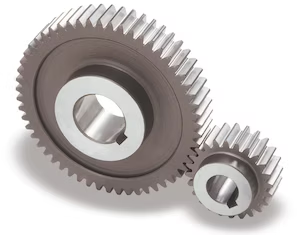
What are the potential challenges in designing and manufacturing spur gears?
Designing and manufacturing spur gears involve several challenges that need to be addressed to ensure optimal performance and reliability. Here’s a detailed explanation of the potential challenges in designing and manufacturing spur gears:
- Gear Tooth Design: Designing the gear tooth profile is a critical aspect of gear design. Achieving the desired tooth shape, pressure angle, and tooth thickness distribution while considering factors such as load capacity, durability, and noise generation can be challenging. Iterative design processes, computer-aided design (CAD) software, and gear design expertise are often employed to overcome these challenges.
- Material Selection: Choosing the appropriate material for gear manufacturing is crucial. Gears need to withstand high loads, transmit power efficiently, and exhibit excellent wear resistance. Selecting materials with suitable hardness, strength, and fatigue resistance can be challenging, especially when considering factors such as cost, availability, and compatibility with other components in the gear system.
- Manufacturing Processes: The manufacturing processes for producing spur gears, such as hobbing, shaping, or broaching, can present challenges. Achieving precise gear tooth profiles, accurate dimensions, and proper surface finish requires advanced machining techniques, specialized equipment, and skilled operators. Maintaining tight tolerances and ensuring consistent quality during mass production can also be demanding.
- Tooth Surface Finish: The surface finish of gear teeth plays a crucial role in gear performance. Achieving a smooth and precise tooth surface finish is challenging due to factors such as tool wear, heat generation during manufacturing, and the complexity of the gear tooth profile. Surface finishing processes, such as grinding or honing, may be required to achieve the desired surface quality.
- Noise and Vibration: Gears can generate noise and vibration during operation, which can affect the overall performance and user experience. Designing gears to minimize noise and vibration requires careful consideration of factors such as tooth profile optimization, load distribution, gear meshing characteristics, and proper lubrication. Conducting noise and vibration analysis and implementing appropriate design modifications may be necessary to address these challenges.
- Backlash Control: Controlling backlash, the slight gap between mating gear teeth, can be challenging. Backlash affects gear accuracy, smoothness of operation, and the ability to transmit torque efficiently. Balancing the need for adequate backlash to accommodate thermal expansion and minimize gear engagement issues while ensuring precise control of backlash can be a complex task in gear design and manufacturing.
- Heat Treatment: Heat treatment processes, such as carburizing or quenching, are often employed to enhance the hardness and strength of gear teeth. Proper heat treatment is crucial to achieve the desired material properties and gear performance. However, challenges such as distortion, residual stresses, and material property variations can arise during heat treatment, requiring careful process control, post-heat treatment machining, or additional treatments to mitigate these challenges.
- Quality Control: Ensuring consistent quality and reliability of spur gears is a challenge in manufacturing. Implementing effective quality control measures, such as dimensional inspections, hardness testing, and gear tooth profile analysis, is essential. Statistical process control (SPC) techniques and quality assurance systems help monitor manufacturing processes, identify potential issues, and maintain consistent gear quality.
- Cost and Time Constraints: Designing and manufacturing spur gears that meet performance requirements within cost and time constraints can be challenging. Balancing factors such as material costs, tooling expenses, production lead times, and market competitiveness requires careful consideration and optimization. Efficient production planning, cost analysis, and value engineering techniques are often employed to address these challenges.
By recognizing these challenges and employing appropriate design methodologies, manufacturing techniques, and quality control measures, it is possible to overcome the potential challenges associated with designing and manufacturing spur gears.
It’s important to note that the specific challenges may vary depending on the gear application, size, complexity, and operating conditions. Collaboration with gear design experts, manufacturing engineers, and industry specialists can provide valuable insights and guidance in addressing the challenges specific to your spur gear design and manufacturing processes.
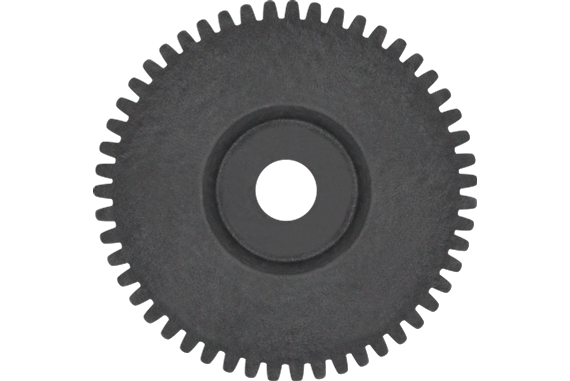
What is the purpose of using spur gears in machinery?
In machinery, spur gears serve several important purposes due to their unique characteristics and capabilities. Here’s a detailed explanation of the purpose of using spur gears in machinery:
- Power Transmission: Spur gears are primarily used for power transmission in machinery. They transfer rotational motion and torque from one shaft to another, allowing machinery to perform various tasks. By meshing the teeth of two or more spur gears together, power can be transmitted efficiently and reliably throughout the machinery.
- Speed Reduction or Increase: Spur gears enable speed reduction or increase in machinery. By combining gears with different numbers of teeth, the rotational speed can be adjusted to match the desired output speed. For example, using a larger gear driving a smaller gear can increase the speed output while reducing the torque, while the opposite arrangement can decrease the speed while increasing the torque.
- Torque Amplification: Spur gears can amplify torque in machinery. By using gears with different numbers of teeth, the torque can be adjusted to match the required output. For example, using a smaller gear driving a larger gear can increase the torque output while reducing the speed, while the opposite arrangement can decrease the torque while increasing the speed.
- Directional Control: Spur gears provide directional control in machinery. By meshing gears with opposite orientations, the rotational direction of the driven shaft can be reversed or changed. This directional control is crucial for machinery that requires bi-directional motion or needs to change the direction of operation.
- Mechanical Advantage: Spur gears offer a mechanical advantage in machinery. By utilizing gear ratios, spur gears can multiply or divide the force exerted on the input shaft. This mechanical advantage allows machinery to generate higher forces or achieve precise movements with reduced effort.
- Precision Positioning: Spur gears facilitate precise positioning in machinery. The accurate tooth engagement of spur gears ensures precise control over rotational motion, making them suitable for applications that require precise positioning or synchronization of components. Machinery such as CNC machines, robotics, and automation systems often rely on spur gears for accurate movement and positioning.
- Compact Design: Spur gears have a compact design, making them suitable for machinery with space constraints. They can be arranged in-line, parallel, or at right angles, allowing for efficient power transmission in tight spaces. Their compactness enables machinery to be designed with smaller footprints and optimized layouts.
- Reliability and Durability: Spur gears are known for their reliability and durability in machinery. The direct tooth engagement and uniform load distribution result in efficient power transmission with reduced wear and stress concentration. When properly lubricated and maintained, spur gears can withstand heavy loads and operate reliably over extended periods.
- Cost-Effectiveness: Spur gears are often cost-effective in machinery applications. Their simple design and ease of manufacturing contribute to lower production costs. Additionally, their high efficiency helps reduce energy consumption, resulting in potential long-term cost savings. The availability of spur gears in various sizes and materials further enhances their cost-effectiveness.
By utilizing spur gears in machinery, engineers and designers can achieve efficient power transmission, speed and torque control, directional versatility, mechanical advantage, precise positioning, compact design, reliability, durability, and cost-effectiveness. These advantages make spur gears a popular choice in a wide range of machinery applications across industries.
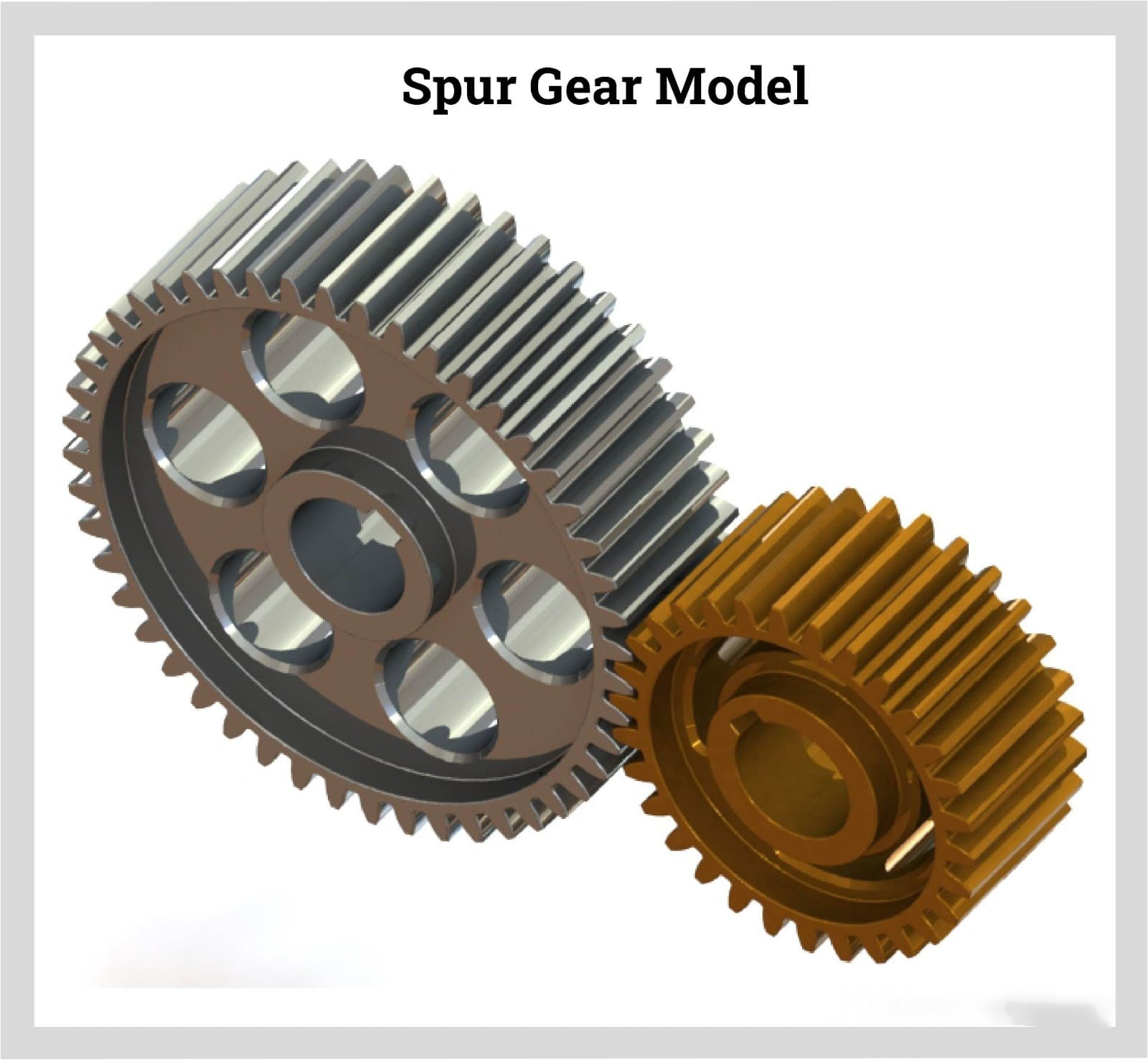
How do spur gears differ from other types of gears?
Spur gears, as a specific type of gear, possess distinct characteristics and features that set them apart from other types of gears. Here’s a detailed explanation of how spur gears differ from other types of gears:
- Tooth Geometry: One of the primary differences lies in the tooth geometry. Spur gears have straight teeth that are cut parallel to the gear axis. This differs from other gear types, such as helical gears or bevel gears, which have angled or curved teeth.
- Gear Meshing: Spur gears mesh by direct contact between their teeth, creating a line or point contact. This meshing arrangement is different from other gear types, such as worm gears or planetary gears, where the teeth mesh in a different manner, such as through sliding contact or multiple points of contact.
- Direction of Force: Spur gears transmit rotational motion and torque in a specific direction. The force is transmitted along the axis of the gears, making them suitable for parallel shaft arrangements. In contrast, other types of gears, such as bevel gears or hypoid gears, can transmit motion between non-parallel or intersecting shafts.
- Noise and Vibration: Spur gears tend to produce more noise and vibration compared to certain other gear types. The direct contact between the teeth and the sudden engagement/disengagement of the teeth can generate impact forces, leading to noise and vibration. In contrast, gear types like helical gears or double-enveloping worm gears provide smoother meshing and reduced noise levels.
- Efficiency and Load Distribution: Spur gears generally offer high efficiency in power transmission due to their direct tooth engagement. However, they may experience higher stress concentrations and load concentrations compared to other gear types. Gear designs like helical gears or planetary gears can distribute the load more evenly across the teeth, reducing stress concentrations.
- Applications: Spur gears find widespread applications in various industries and equipment. Their simplicity, ease of manufacture, and cost-effectiveness make them suitable for a wide range of systems. Other gear types have specific applications where their unique characteristics, such as high torque transmission, precise motion control, or compact size, are advantageous.
In summary, spur gears differ from other types of gears in terms of tooth geometry, gear meshing, direction of force transmission, noise and vibration characteristics, load distribution, and specific applications. Understanding these differences is crucial when selecting the appropriate gear type for a particular mechanical system, considering factors such as load requirements, motion control, efficiency, and design constraints.


editor by CX 2024-01-10