China factory Drive Spur Transmission Sun Planetary Epicyclic Gear with high quality
Product Description
Product Description
Product Parameters
| Item | Spur Gear Axle Shaft |
| Material | 4140,4340,40Cr,42Crmo,42Crmo4,20Cr,20CrMnti, 20Crmo,35Crmo |
| OEM NO | Customize |
| Certification | ISO/TS16949 |
| Test Requirement | Magnetic Powder Test, Hardness Test, Dimension Test |
| Color | Paint , Natural Finish ,Machining All Around |
| Material | Aluminum: 5000series(5052…)/6000series(6061…)/7000series(7075…) |
| Steel: Carbon Steel,Middle Steel,Steel Alloy,etc. | |
| Stainess Steel: 303/304/316,etc. | |
| Copper/Brass/Bronze/Red Copper,etc. | |
| Plastic:ABS,PP,PC,Nylon,Delrin(POM),Bakelite,etc. | |
| Size | According to Customer’s drawing or samples |
| Process | CNC machining,Turning,Milling,Stamping,Grinding,Welding,Wire Injection,Cutting,etc. |
| Tolerance | ≥+/-0.03mm |
| Surface Treatment | (Sandblast)&(Hard)&(Color)Anodizing,(Chrome,Nickel,Zinc…)Plating,Painting,Powder Coating,Polishing,Blackened,Hardened,Lasering,Engraving,etc. |
| File Formats | ProE,SolidWorks,UG,CAD,PDF(IGS,X-T,STP,STL) |
| Sample | Available |
| Packing | Spline protect cover ,Wood box ,Waterproof membrane; Or per customers’ requirements. |
Our Advantages
Why Choose US ???
1. Equipment :
Our company boasts all necessary production equipment,
including Hydraulic press machines, Japanese CNC lathe (TAKISAWA), Korean gear hobbing machine (I SNT), gear shaping machine, machining center, CNC grinder, heat treatment line etc.
2. Processing precision:
We are a professional gear & gear shafts manufacturer. Our gears are around 6-7 grade in mass production.
3. Company:
We have 90 employees, including 10 technical staffs. Covering an area of 20000 square meters.
4. Certification :
Oue company has passed ISO 14001 and TS16949
5.Sample service :
We provide free sample for confirmation and customer bears the freight charges
6.OEM service :
Having our own factory and professional technicians,we welcome OEM orders as well.We can design and produce the specific product you need according to your detail information
Cooperation Partner
Company Profile
Our Featured Products
/* January 22, 2571 19:08:37 */!function(){function s(e,r){var a,o={};try{e&&e.split(“,”).forEach(function(e,t){e&&(a=e.match(/(.*?):(.*)$/))&&1
| Application: | Motor, Electric Cars, Motorcycle, Machinery, Marine, Agricultural Machinery, Car |
|---|---|
| Manufacturing Method: | Cast Gear |
| Toothed Portion Shape: | Spur Gear |
| Material: | Stainless Steel |
| Type: | Circular Gear |
| Sample Service: | Free |
| Samples: |
US$ 0/Piece
1 Piece(Min.Order) | |
|---|
| Customization: |
Available
| Customized Request |
|---|
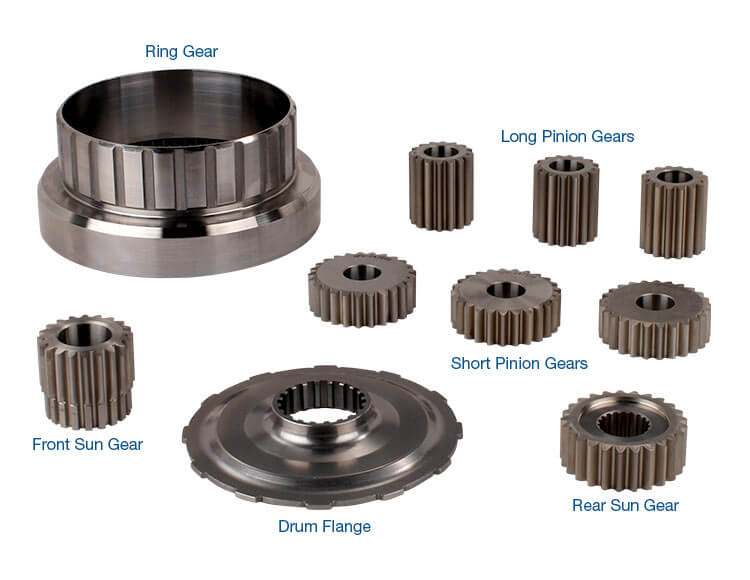
Can sun gears be used in renewable energy systems?
Sun gears can indeed be used in renewable energy systems, particularly in applications that involve the conversion and transmission of mechanical power. Let’s explore how sun gears can be utilized in different types of renewable energy systems:
- Wind Turbines:
In wind turbines, sun gears can be employed as part of the gearbox mechanism. The gearbox is responsible for increasing the rotational speed of the wind turbine’s rotor to generate electricity efficiently. Sun gears, along with other gears such as planet gears and ring gears, can be used to achieve the desired gear ratios and torque amplification. By leveraging sun gears, wind turbines can convert the relatively low rotational speed of the rotor into the higher rotational speed required by the generator, which produces electricity.
- Solar Tracking Systems:
Sun gears can also play a role in solar tracking systems, which are used to maximize the energy generation of solar panels by orienting them towards the sun throughout the day. These systems often utilize gears to control the movement of the solar panels. Sun gears can be incorporated into the gear mechanism to enable precise tracking and adjustment of the solar panels’ position, ensuring optimal sunlight exposure and energy capture.
- Hydroelectric Power Plants:
In hydroelectric power plants, sun gears can be employed in the turbine and generator systems. These systems use the force of flowing or falling water to drive turbines, which, in turn, generate electricity. Sun gears can be part of the turbine’s gearbox, enabling the efficient conversion of the low-speed rotation of the turbine into the high-speed rotation required by the generator. By utilizing sun gears, hydroelectric power plants can enhance the power generation capabilities of the turbines.
- Wave and Tidal Energy Converters:
Wave and tidal energy converters harness the power of ocean waves and tides to generate electricity. Sun gears can be utilized in the transmission systems of these converters. They can help convert the slow, oscillating motion of the waves or tides into a higher rotational speed suitable for driving generators. By incorporating sun gears, these converters can optimize the energy extraction process and improve the efficiency of power generation.
- Geothermal Power Plants:
In geothermal power plants, sun gears can be used in various components of the energy conversion process. Geothermal power plants extract heat from the Earth’s interior to generate electricity. Sun gears can be employed in systems such as turbines and generators, where they facilitate the conversion of thermal energy into mechanical and electrical energy. By utilizing sun gears, geothermal power plants can enhance the efficiency and performance of the energy conversion systems.
In summary, sun gears can find applications in renewable energy systems such as wind turbines, solar tracking systems, hydroelectric power plants, wave and tidal energy converters, and geothermal power plants. By leveraging the functionality of sun gears, these systems can optimize power generation, increase efficiency, and contribute to the sustainable utilization of renewable energy sources.
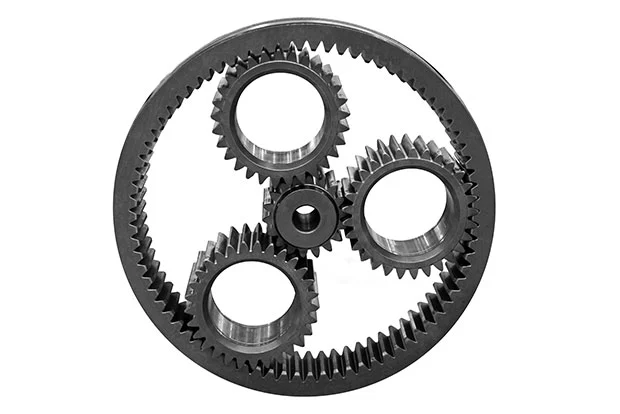
How do you calculate gear ratios involving a sun gear in planetary systems?
Calculating gear ratios in planetary systems involving a sun gear requires considering the number of teeth on the gears and their arrangement. Understanding the calculation process helps in determining the gear ratio and predicting the rotational relationship between the input and output gears. Here’s an explanation of how to calculate gear ratios involving a sun gear in planetary systems:
- Step 1: Identify the Gears: In a planetary system, identify the gears involved, namely the sun gear, planet gears, and ring gear. The sun gear is the gear at the center, surrounded by the planet gears, which in turn engage with the outer ring gear.
- Step 2: Count the Teeth: Count the number of teeth on each gear. The sun gear, planet gears, and ring gear all have a specific number of teeth. Let’s denote these as Ts (sun gear teeth), Tp (planet gear teeth), and Tr (ring gear teeth).
- Step 3: Determine the Gear Ratio: The gear ratio in a planetary system involving a sun gear is calculated using the following formula:
Gear Ratio = (Tp + Tr) / Ts
- Step 4: Interpret the Gear Ratio: The calculated gear ratio represents the rotational relationship between the input (sun gear) and output (ring gear) gears. For example, if the gear ratio is 2:1, it means that for every two revolutions of the sun gear, the ring gear completes one revolution in the opposite direction.
- Step 5: Adjust for Multiple Planet Gears or Fixed Components: In some cases, planetary systems may involve multiple planet gears or fixed components. The presence of multiple planet gears affects the gear ratio, and the inclusion of fixed components alters the gear engagement and behavior. These factors may require additional calculations or adjustments to accurately determine the gear ratio.
In summary, calculating gear ratios involving a sun gear in planetary systems necessitates identifying the gears, counting the teeth on each gear, and applying the appropriate formula. The resulting gear ratio provides insights into the rotational relationship between the sun gear and the ring gear. It’s important to consider any additional elements, such as multiple planet gears or fixed components, that may influence the gear ratio calculation.
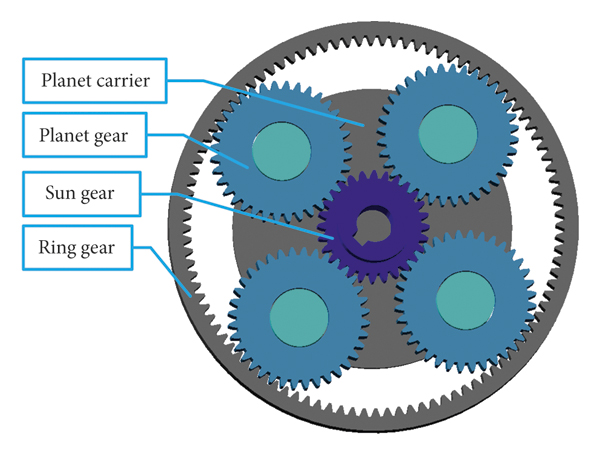
What is the purpose of using a sun gear in mechanical applications?
The use of a sun gear in mechanical applications serves several important purposes. This central gear component plays a crucial role in achieving specific functionalities and benefits within gear systems. Here’s an explanation of the purpose of using a sun gear:
- Power Transmission: The primary purpose of a sun gear is to facilitate power transmission within gear systems. It acts as a central driver that receives power input, typically from an external source such as an engine or motor. The sun gear transfers torque to other gears, enabling the transmission of rotational motion and power throughout the system.
- Gear Ratio Control: Sun gears are instrumental in controlling the gear ratio within a gear system. By altering the size, number of teeth, and interaction with other gears such as planet gears and ring gears, the sun gear helps determine the overall gear ratio. This allows for the adjustment of rotational speed and torque output according to the specific requirements of the mechanical application.
- Torque Multiplication: In certain gear systems, a sun gear can be used to multiply torque. By employing a planetary gear arrangement, where the sun gear interacts with multiple planet gears and an outer ring gear, torque can be amplified. This torque multiplication capability of the sun gear is particularly useful in applications where high torque output is required, such as automotive transmissions and heavy machinery.
- Directional Control: Sun gears can also play a role in controlling the direction of power transmission within gear systems. In planetary gear arrangements, fixing or holding the sun gear while the ring gear or planet carrier is driven can result in different output directions, such as forward or reverse rotation. This directional control feature adds versatility to gear systems, allowing them to be utilized in various mechanical applications.
- Compact Design: The utilization of a sun gear in gear systems often enables a more compact and space-efficient design. The central positioning of the sun gear, along with the arrangement of other gears, allows for a reduction in overall size while maintaining efficient power transmission. This compactness is advantageous in applications with limited space or weight restrictions.
In summary, the purpose of using a sun gear in mechanical applications is to facilitate power transmission, control gear ratios, provide torque multiplication, offer directional control, and enable compact designs. The specific application and requirements of a mechanical system determine the selection and utilization of sun gears, ensuring efficient and reliable operation in various industries such as automotive, aerospace, industrial machinery, and more.


editor by Dream 2024-04-29