China factory High Precision CNC Machine Gear Shaft for Lithium Battery Electric Cars with ISO9001 supplier
Product Description
Product Parameters
| product name | High Precision CNC Machine Gear Shaft for Lithium Battery Electric Cars with ISO9001 |
| material | stainless steel , iron , aluminum ,bronze ,carbon steel ,brass etc . |
| size | ISO standard ,customer requirements |
| surface treatment | Carburizing and Quenching,Tempering ,Tooth suface high quenching Hardening,Tempering |
| Processing Method | Molding, Shaving, Hobbing, Drilling, Tapping, Reaming, Manual Chamfering, Grinding etc |
| Heat Treatment | Quenching & Tempering, Carburizing & Quenching, High-frequency Hardening, Carbonitriding…… |
| Package | Wooden Case/Container and pallet, or made-to-order / carton box |
| Certificate | ISO9001 |
| Machining Process | Gear Hobbing, Gear Milling, Gear Shaping, Gear Broaching, Gear Shaving, Gear Grinding and Gear Lapping |
| Applications | Toy, Automotive, instrument, electrical equipment, household appliances, furniture, mechanical equipment,daily living equipment, electronic sports equipment, , sanitation machinery, market/ hotel equipment supplies, etc. |
| Testing Equipment | Rockwell hardness tester 500RA, Double mesh instrument HD-200B & 3102 |
Company Profile
Application Field
FAQ
1. why should you buy products from us not from other suppliers?
We are a 32 year-experience manufacturer on making the gear, specializing in manufacturing varieties of gears, such as helical gear ,bevel gear ,spur gear and grinding gear, gear shaft, timing pulley, rack, , timing pulley and other transmission parts .
2. what services can we provide?
Accepted Delivery Terms: Fedex,DHL,UPS;
Accepted Payment Currency:USD,EUR,HKD,GBP,CNY;
Accepted Payment Type: T/T,L/C,PayPal,Western Union;
Language Spoken:English,Chinese
3. how can we guarantee quality?
1 .Always a pre-production sample before mass production;
2 .Always final Inspection before shipment;
3 .We have high-precision CNC gear grinding machine, high-speed CNC gear hobbing machine, CNC gear shaping machine, CNC lathe, CNC machining center, various grinding machines, universal gear measuring instrument, heat treatment and other advanced processing equipment.
4 . We have a group of experienced technical workers, more than 90% of the workers have more than 10 years of work experience in this factory, can accurately control the manufacturing of products and customer needs. We regularly train our employees to ensure that we can produce high-precision and high-quality products that are more in line with our customers’ needs.
/* January 22, 2571 19:08:37 */!function(){function s(e,r){var a,o={};try{e&&e.split(“,”).forEach(function(e,t){e&&(a=e.match(/(.*?):(.*)$/))&&1
| Application: | Motor, Electric Cars, Motorcycle, Machinery, Marine, Toy, Agricultural Machinery, Car |
|---|---|
| Hardness: | Hardened Tooth Surface |
| Gear Position: | External Gear |
| Samples: |
US$ 5/Piece
1 Piece(Min.Order) | Order Sample |
|---|
| Customization: |
Available
| Customized Request |
|---|
.shipping-cost-tm .tm-status-off{background: none;padding:0;color: #1470cc}
|
Shipping Cost:
Estimated freight per unit. |
about shipping cost and estimated delivery time. |
|---|
| Payment Method: |
|
|---|---|
|
Initial Payment Full Payment |
| Currency: | US$ |
|---|
| Return&refunds: | You can apply for a refund up to 30 days after receipt of the products. |
|---|
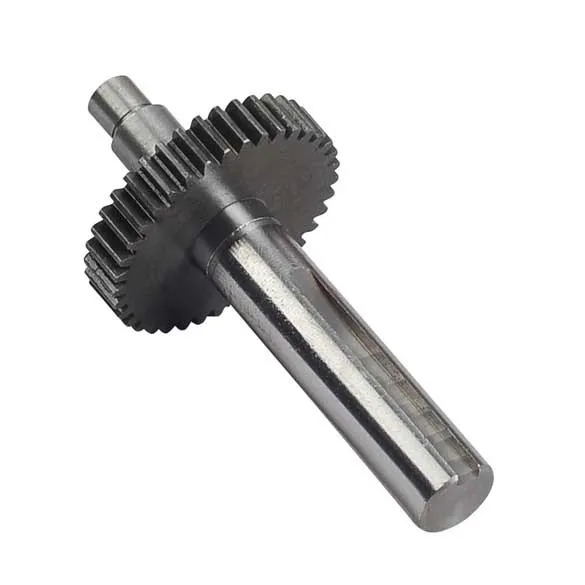
Can gear shafts be used in precision machinery and equipment?
Yes, gear shafts are commonly used in precision machinery and equipment. Precision machinery requires high accuracy, reliability, and smooth operation, and gear shafts play a critical role in achieving these requirements. Let’s explore the reasons why gear shafts are suitable for precision machinery:
- Power Transmission:
Gear shafts are essential components for transmitting power between various components in precision machinery. They enable the transfer of rotational motion and torque from the input source to the desired output, allowing the machinery to perform its intended function precisely and efficiently.
- Precise Positioning and Control:
Gear shafts, along with gears and other related components, enable precise positioning and control in precision machinery. By utilizing carefully designed gear ratios and configurations, gear shafts can accurately control the speed, direction, and timing of movements within the machinery. This precision is crucial in applications such as robotics, CNC machines, and other automated systems.
- Load Distribution:
In precision machinery, gear shafts help distribute loads evenly across various components. By utilizing multiple gears and shafts, the transmitted load can be distributed over a larger surface area, reducing stress concentrations and minimizing the risk of premature wear or failure. This load distribution capability is vital in maintaining the integrity and longevity of precision machinery.
- Backlash Control:
Backlash refers to the slight clearance or play between meshing gears. In precision machinery, it is crucial to minimize or control backlash to ensure accurate and repeatable movements. Gear shafts, when properly designed and manufactured, can contribute to minimizing backlash by maintaining precise gear meshing and reducing any unwanted movement or play between the gears.
- High Torque Transmission:
Precision machinery often requires the transmission of high torque while maintaining accuracy and reliability. Gear shafts are capable of handling high torque loads and transmitting power efficiently. They are designed to withstand the forces and stresses associated with high torque applications, ensuring reliable operation and minimizing power losses.
- Customization and Adaptability:
Gear shafts can be customized and adapted to meet the specific requirements of precision machinery. They can be manufactured with various materials, such as steel or specialized alloys, to achieve the desired strength, durability, and dimensional accuracy. The gear profiles, shaft dimensions, and other parameters can be tailored to suit the particular application, allowing for optimal performance and compatibility within precision machinery.
- Reliability and Longevity:
Gear shafts are known for their reliability and long service life when properly designed, manufactured, and maintained. They are subjected to rigorous quality control measures to ensure dimensional accuracy, surface finish, and appropriate hardness. This focus on quality and precision results in gear shafts that can withstand demanding operating conditions and provide consistent performance over an extended period.
In summary, gear shafts are indeed suitable for use in precision machinery and equipment. Their ability to transmit power, enable precise positioning and control, distribute loads, control backlash, handle high torque transmission, offer customization options, and provide reliability and longevity make them essential components in achieving the accuracy and performance required by precision machinery.
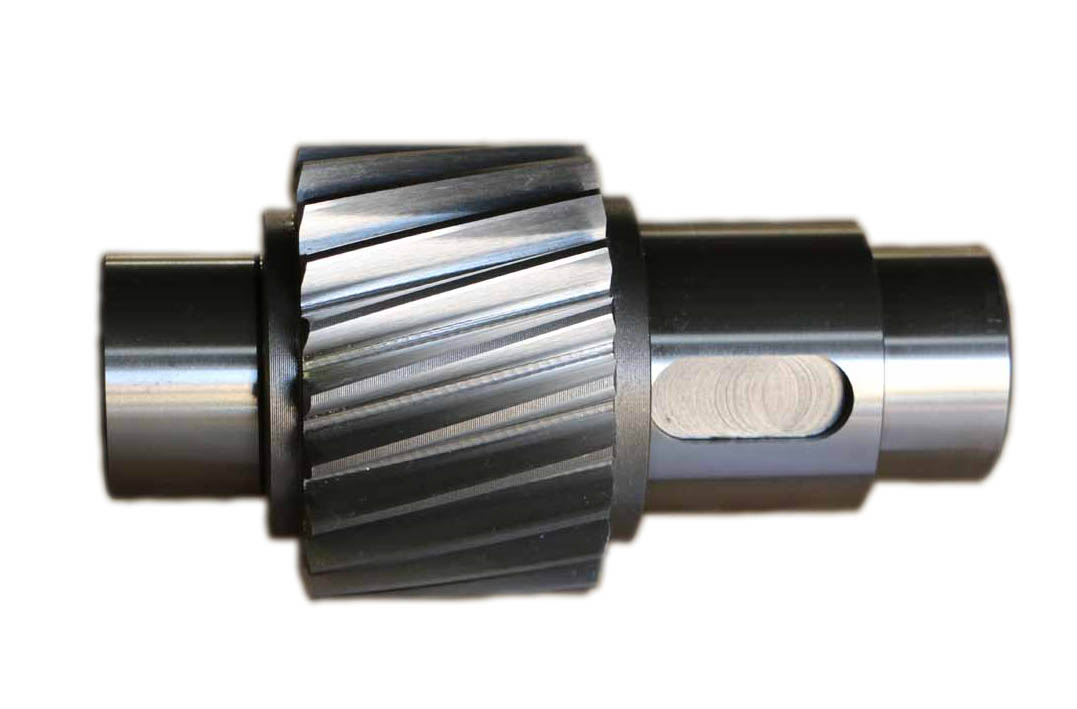
What are the advantages of using a gear shaft in various gear arrangements?
A gear shaft offers several advantages when used in various gear arrangements within mechanical systems. It plays a critical role in transmitting motion and power efficiently. Here are the advantages of using a gear shaft:
- Mechanical Power Transmission:
A gear shaft enables the transmission of mechanical power between gears in a gear arrangement. By connecting and meshing with multiple gears, the gear shaft efficiently transfers rotational motion and torque from the driving gear to the driven gear. This power transmission capability allows for the amplification, reduction, or redirection of power as required by the mechanical system, enabling the efficient operation of machinery and equipment.
- Speed and Torque Conversion:
With the use of different gear arrangements on a gear shaft, it becomes possible to convert speed and torque. By employing gears with different numbers of teeth or gear ratios, the rotational speed and torque output can be adjusted. Gear arrangements like spur gears, helical gears, bevel gears, and planetary gears on the gear shaft allow for precise speed and torque conversion, enabling the adaptation of mechanical systems to specific requirements.
- Mechanical Advantage:
A gear shaft offers the advantage of mechanical advantage. By incorporating gears with different sizes or gear ratios, the gear shaft can provide mechanical advantage in terms of torque amplification or speed reduction. This allows for the efficient utilization of available power and the optimization of mechanical system performance. Mechanical advantage is particularly beneficial in applications where high torque or precise speed control is required.
- Versatility and Flexibility:
The use of a gear shaft provides versatility and flexibility in gear arrangements. Different types of gears can be mounted on the gear shaft, allowing for the creation of complex gear systems. Gear arrangements can be customized based on the specific requirements of the mechanical system, such as space constraints, torque demands, and speed ranges. The gear shaft’s versatility enables the implementation of various gear combinations, making it adaptable to a wide range of applications.
- Smooth and Reliable Operation:
When properly designed and manufactured, a gear shaft ensures smooth and reliable operation of the gear arrangement. The gear teeth on the gears mesh with precision, guided by the gear shaft, resulting in minimal noise, vibration, and backlash. The gear shaft’s stable and accurate rotation facilitates the synchronized movement of gears, promoting efficient power transmission and reducing wear on the gear teeth. This contributes to the overall longevity and reliability of the mechanical system.
- Durability and Load Capacity:
A gear shaft, constructed from durable materials and designed to handle high loads, offers excellent durability and load-carrying capacity. The gear shaft’s robust construction allows it to withstand the forces and stresses encountered during power transmission. It ensures the gear arrangement can handle the required torque, resist deformation, and maintain its integrity under demanding operating conditions.
In summary, the advantages of using a gear shaft in various gear arrangements include mechanical power transmission, speed and torque conversion, mechanical advantage, versatility and flexibility, smooth and reliable operation, durability, and load-carrying capacity. Gear shafts are essential components that enhance the performance, efficiency, and reliability of mechanical systems.
What is the purpose of using a gear shaft in machinery?
A gear shaft serves several essential purposes in machinery. It plays a crucial role in the efficient operation and transmission of power within mechanical systems. Here are the main purposes of using a gear shaft:
- Power Transmission:
A primary purpose of a gear shaft is to transmit power between different components in a machinery. When rotational force or torque is applied to the gear shaft, it transfers this power to connected gears or mechanisms. This power transmission allows for the controlled and synchronized movement of various parts, enabling the machinery to perform its intended function.
- Torque Conversion and Adjustment:
By utilizing different sizes and arrangements of gears on the shaft, the gear shaft enables torque conversion and adjustment. Gears with varying numbers of teeth can be connected to the gear shaft, allowing for torque multiplication or reduction. This capability is crucial for adapting the power output of the machinery to match specific requirements, such as increasing torque for heavy-duty operations or reducing torque for precision tasks.
- Speed Control:
Another purpose of a gear shaft is to control the speed of rotational motion in machinery. By using gears of different sizes or gear ratios on the shaft, the rotational speed can be adjusted. For instance, a smaller gear connected to the gear shaft will rotate faster, while a larger gear will rotate slower. This speed control allows for the optimization of machinery performance, ensuring that the rotational speed matches the desired application requirements.
- Directional Change:
A gear shaft also facilitates the change in rotational direction within machinery. By incorporating appropriately designed gears on the shaft, the rotational motion can be redirected by 90 degrees or any desired angle. This directional change ability is vital in machinery that requires motion to be transmitted in different directions or orientations, allowing for complex operations and versatile applications.
- Load Distribution:
Many machinery applications involve the distribution of load or force between multiple components. A gear shaft helps evenly distribute the load among connected gears and mechanisms. As torque is transmitted through the gear shaft, it ensures that the force is distributed across the teeth of the gears, minimizing stress concentration and promoting smooth operation. This load distribution enhances the overall durability and longevity of the machinery.
- Mechanical Redundancy:
In certain machinery designs, gear shafts can provide mechanical redundancy. By incorporating multiple gear shafts that operate in parallel, the machinery can maintain functionality even if one of the gear shafts fails. This redundancy ensures that the machinery continues to operate with minimal disruption, reducing downtime and improving overall reliability.
In summary, the purpose of using a gear shaft in machinery is to enable power transmission, torque conversion and adjustment, speed control, directional change, load distribution, and mechanical redundancy. Gear shafts are essential components that contribute to the efficient and effective operation of various mechanical systems.


editor by Dream 2024-04-22