China Standard Custom Pinion Sintered Forged Spur Internal Box Spline Plastic Steel Gear with Best Sales
Product Description
| Product type | Sintered metal parts / Planetary Sun Drive Spur Gea |
| Material | Stainless steel,Steel(Iron,)Brass,Copper (According to product design requirements) |
| Tolerance | ±0.01mm |
| Surface Treatment | As your requirement |
| Application | Tool industry,Automotive, instrument, electrical equipment, household appliances, furniture, mechanical equipment,daily living equipment, electronic sports equipment, light industry products, sanitation machinery, etc. |
| Shape | Any other material and dimension depends on customers’ demand. |
| QC system | 100% inspection before shipment |
| Returned Goods Managing | With quality problem or deviation from drawings |
| Warranty | Replacement at all our cost for rejected products |
| Payment terms | T/T at sight, Paypal, Western Union,etc. |
| Lead time | 7-15 working days as usual,It will based on the detailed order quantity. |
| Why Choose Us |
1. We have professional powder metallurgy production equipment and team;
2. We can accompany customers to develop products;
3. Just send an idea that you want to try, you don’t even need to know what powder metallurgy;
4. Our sales will reply you within 24 hours to confirm further details and give the estimated quote time;
5. Our team will evaluate your inquiry and provide our offer within next 1~3 working days.
| Order Process |
1. You send us drawing or sample.
2. We carry through project assessment.
3. We give you our design for your confirmation.
4. We make the sample and send it to you after you confirmed our design.
5. You confirm the sample then place an order and pay us deposit.
6. We start producing.
7. When the goods is done, you pay us the balance after you confirmed pictures or tracking numbers.
8. Trade is done, thank you!!
Additional Capabilities CAD Design Services CAM Programming Services Coordinate Measuring Machines (CMM) Reverse Engineering
| Product Show |
| Some Parts We Manufacture |
Self-Lubricated Bushing
Structural Parts
Gears
| About Us |
| Design Tips: Powder Metallurgy Gears |
1. Radius > 0.25 mm is required to manufacture the die;
2. Helical teeth should feature a helical angle < 30º in order to limit side pressure on the punches;
3. Introduction of a draft angle > 5º in the upper diameter reduce the tooling cost;
4. The distance between tooth root and central hub diameter must be: > 3 mm (Robust Tooling).
If you want to know more about the product, please send us a message.
| The Powder Metallurgy Manufacturing Process |
| FAQ |
| Q: How can I get the quotation? |
| A: Please send us information for quote: drawing, material, weight, quantity and request,w can accept PDF, ISGS, DWG, STEP file format. If you don’t have drawing, please send the sample to us,we can quote based on your sample too. |
| Q: What’s your MOQ? |
| A: In general 1000pcs,but can accept low quantity in some special conditions. |
| Q: Do you provide samples ? is it free or extra ? |
| A: Yes, we could offer the sample for free charge but do not pay the cost of freight. |
| Q: What about the leading time for mass production? |
| A: Honestly, it depends on the order quantity. Normally, 15 days to 20 days after your deposit if no tooling needed. |
| Q: What if the parts are not good? |
| A: We can guarantee good quality,but if happened,please contact us immediately, take some pictures, we will check on the problem,and solve it asap. |
| Q: What is your terms of payment ? |
| A: Payment=1000USD, 30% T/T in advance ,balance before shippment |
| Application: | Motor, Electric Cars, Motorcycle, Machinery, Marine, Agricultural Machinery, Car |
|---|---|
| Hardness: | Hardened Tooth Surface |
| Gear Position: | Internal Gear |
| Customization: |
Available
| Customized Request |
|---|
.shipping-cost-tm .tm-status-off{background: none;padding:0;color: #1470cc}
|
Shipping Cost:
Estimated freight per unit. |
about shipping cost and estimated delivery time. |
|---|
| Payment Method: |
|
|---|---|
|
Initial Payment Full Payment |
| Currency: | US$ |
|---|
| Return&refunds: | You can apply for a refund up to 30 days after receipt of the products. |
|---|

How do you address noise and vibration issues in a spur gear system?
Noise and vibration issues in a spur gear system can significantly impact its performance, efficiency, and overall user experience. Here’s a detailed explanation of how to address noise and vibration issues in a spur gear system:
- Gear Design: Optimize the gear design to minimize noise and vibration. Consider factors such as tooth profile, gear module or pitch, and the number of teeth to ensure smooth and quiet gear operation. Proper gear design helps reduce gear meshing impacts and tooth-to-tooth variations, which are common sources of noise and vibration.
- Accurate Gear Alignment: Ensure precise gear alignment to minimize misalignment-induced noise and vibration. Misalignment between the gears can cause uneven loading, increased backlash, and gear meshing irregularities, leading to noise and vibration. Proper alignment techniques, such as using alignment tools or measuring devices, should be employed during gear installation and maintenance.
- Surface Finish and Tooth Quality: Ensure proper surface finish and high-quality tooth profiles on the gears. Rough surfaces or manufacturing defects can contribute to noise and vibration. Gears with accurate tooth profiles and smooth finishes experience better meshing and reduced friction, resulting in lower noise and vibration levels.
- Lubrication: Proper lubrication is crucial for reducing friction, wear, and noise generation in spur gear systems. Use the recommended lubricant type and ensure sufficient lubricant film thickness between gear teeth. Regular lubricant analysis and replacement are important to maintain optimal lubrication performance and minimize noise and vibration issues.
- Load Distribution: Evaluate the load distribution within the gear system to minimize localized loading and potential noise sources. Proper gear design, tooth profile optimization, and gear arrangement can help distribute the load evenly, reducing noise and vibration caused by uneven loading conditions.
- Resonance Analysis and Damping: Conduct resonance analysis to identify and address potential resonant frequencies within the gear system. Resonance can amplify noise and vibration. Techniques such as adding damping materials, using vibration isolators, or adjusting gear configurations can help mitigate resonance-related noise and vibration issues.
- Noise and Vibration Testing: Perform noise and vibration testing during the development and maintenance stages of the gear system. This involves using specialized equipment to measure and analyze noise and vibration levels. Testing helps identify specific sources of noise and vibration, allowing for targeted solutions and improvements.
- Isolation and Absorption: Implement isolation and absorption techniques to minimize noise and vibration transmission to surrounding structures or components. This can include using vibration isolators, resilient mounts, or incorporating vibration-absorbing materials to reduce the propagation of noise and vibration beyond the gear system.
- Regular Maintenance and Inspection: Implement a proactive maintenance program to monitor gear performance and identify potential noise and vibration issues. Regular inspections, including gear tooth wear analysis, lubricant checks, and alignment verification, allow for early detection and rectification of any problems that may contribute to noise and vibration.
By considering these approaches and implementing appropriate measures, it is possible to address noise and vibration issues in a spur gear system, resulting in quieter and smoother gear operation.
It’s important to note that the specific techniques and solutions for addressing noise and vibration may vary depending on the gear system’s application, design, and operating conditions. Consulting with gear manufacturers, industry experts, or vibration specialists can provide further guidance in addressing noise and vibration issues specific to a spur gear system.
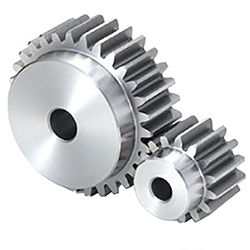
What are the advantages and disadvantages of using spur gears?
Spur gears offer several advantages and disadvantages when used in mechanical systems. Here’s a detailed explanation of the advantages and disadvantages of using spur gears:
Advantages of Spur Gears:
- Simplicity: Spur gears have a simple and straightforward design, consisting of cylindrical gears with straight teeth. Their simplicity facilitates ease of manufacturing, installation, and maintenance.
- Efficiency: Spur gears are highly efficient in transmitting power from one shaft to another. They have minimal sliding friction between the gear teeth, resulting in high mechanical efficiency.
- Cost-Effectiveness: Due to their simple design and ease of production, spur gears are generally more cost-effective compared to other types of gears. They are widely available and can be manufactured in large quantities at a reasonable cost.
- Compactness: Spur gears have a compact design, making them suitable for applications where space is limited. They can be arranged in parallel or stacked configurations to achieve the desired gear ratios within a confined space.
- High Load Capacity: Spur gears can handle high load capacities and transmit substantial amounts of torque. Their teeth are designed to distribute the load evenly across the gear face, resulting in improved load-bearing capabilities.
- Precision: Spur gears provide precise and predictable motion due to the simplicity of their tooth engagement. This makes them suitable for applications that require accurate positioning and synchronization.
Disadvantages of Spur Gears:
- Noisy Operation: Spur gears can produce noise during operation, especially at high speeds. The engagement of the gear teeth generates impact and vibration, resulting in noise that may require additional measures to mitigate.
- Axial Thrust: Spur gears generate axial thrust forces along the gear shafts due to the parallel arrangement of their teeth. This thrust must be properly managed using thrust bearings or other means to prevent excessive axial loading on the gear shafts.
- Limited Speed Ratio: Spur gears are primarily designed for applications with moderate speed ratios. They are less suitable for high-speed applications due to the limitations imposed by the tooth engagement and potential for increased noise and vibration.
- Unidirectional Operation: Spur gears are typically designed for unidirectional power transmission. Reversing the direction of rotation can cause noise, impact, and increased wear due to the abrupt change in tooth engagement.
- Prone to Wear: The sliding contact between the gear teeth in spur gears can result in wear over time, especially under heavy loads or inadequate lubrication. Regular maintenance and proper lubrication are necessary to minimize wear and extend gear life.
It’s important to consider these advantages and disadvantages when selecting gear types for specific applications. While spur gears are well-suited for many applications, other gear types, such as helical gears or bevel gears, may be more suitable in certain situations depending on the requirements and operating conditions.
What are the applications of spur gears?
Spur gears find a wide range of applications in various mechanical systems due to their simplicity, efficiency, and versatility. These gears are commonly used in numerous industries and equipment. Here’s a detailed explanation of the applications of spur gears:
- Automotive Industry: Spur gears are extensively used in automobiles for power transmission applications. They are employed in gearboxes, differentials, and transmission systems to transfer torque and rotational motion between the engine, wheels, and other components.
- Machinery and Manufacturing: Spur gears are widely utilized in machinery and manufacturing equipment. They play a crucial role in conveyor systems, machine tools, printing presses, textile machinery, packaging machinery, and various other industrial applications.
- Power Generation: Spur gears are employed in power generation systems such as wind turbines, hydroelectric turbines, and steam turbines. They help convert the rotational motion of the turbine blades into electricity by transmitting power from the rotor to the generator.
- Robotics and Automation: Spur gears are commonly used in robotics and automation systems. They are utilized in robotic joints, actuators, and drive systems to control motion and transmit torque accurately and efficiently.
- Aerospace and Aviation: Spur gears are found in various aerospace and aviation applications. They are used in aircraft landing gear systems, engine components, flight control systems, and auxiliary power units (APUs) to transmit power and control movement.
- Marine and Shipbuilding: Spur gears have applications in the marine and shipbuilding industry. They are used in propulsion systems, winches, steering mechanisms, and other equipment that require torque transmission and speed control.
- Appliances and Household Equipment: Spur gears are present in numerous household appliances and equipment. They are found in washing machines, dishwashers, mixers, food processors, garage door openers, and many other appliances that require rotational motion and power transmission.
- Power Tools: Spur gears are utilized in power tools such as drills, saws, grinders, and sanders. They help transmit power from the motor to the tool’s cutting or grinding components, enabling efficient operation.
- Medical Equipment: Spur gears are used in various medical devices and equipment. They can be found in imaging systems, surgical robots, medical pumps, and other applications that require precise motion control and torque transmission.
- Clocks and Watches: Spur gears are an essential component in mechanical clocks and watches. They are responsible for accurate timekeeping by transferring rotational motion from the mainspring or oscillator to the hour, minute, and second hands.
These are just a few examples of the broad range of applications where spur gears are utilized. Their simplicity, reliability, and ability to transmit power and motion efficiently make them a popular choice in various industries and equipment.


editor by CX 2023-11-28